

OptiMonk review
AI-built popups and on-site messaging for ecommerce, priced by pageviews
Independent review. If you buy through links on this page we may earn a commission, at no extra cost to you. It never changes our scores — how we test.
ToolsGavel verdict
OptiMonk's free tier is real and its core popup features aren't gated behind paid tiers, which is unusual for the category. But a recurring Trustpilot pattern of unexplained charges and the gap between the 'only pageviews differ' pitch and the actual plan structure mean anyone picking a tier should read the plan selector closely before committing to annual billing.
Audited price: $19/mo billed annually , $29/mo month-to-month (advertised: $29/mo (Essential, billed monthly)) — verified 2026-10-16.
Best for: Ecommerce and marketing teams that want AI-built popups with a usable free tier, and who are ready to check the plan selector instead of trusting the headline price for their traffic level
What we liked
- The Free plan runs 10,000 pageviews a month indefinitely, with no expiration date and no credit card required to start (optimonk.com/pricing)
- Core features, including A/B testing, the full integration list and the absence of OptiMonk branding, apply to every plan including Free, not just the paid tiers (optimonk.com/pricing)
- Hitting the pageview ceiling pauses campaigns instead of triggering an automatic overage charge, and campaigns restart on upgrade or at the next monthly reset (optimonk.com/pricing)
- The Shopify App Store rates it 4.8 out of 5 across 456 reviews, with 92% five-star (Shopify App Store)
What to watch
- Sidemessage, sticky bar and embedded formats only keep working on older accounts: the current AI-driven builder can't create new campaigns in those formats (OptiMonk Help Center)
- Trustpilot shows a recurring complaint pattern about unexplained charges and refund friction, including one reviewer describing two years of unexplained billing and another describing an unresolved $800 charge (Trustpilot)
- Each plan's pageview allowance is listed as a range instead of a fixed number, so the exact price at a given traffic level isn't visible without opening the plan selector (optimonk.com/pricing)
- Despite the pitch that plans differ only by pageviews, domains, AI credits and access to a dedicated account manager all scale with the tier picked (optimonk.com/pricing)
How much does OptiMonk really cost?
| Advertised price | $29/mo (Essential, billed monthly) |
|---|---|
| Real monthly cost, billed annually | $19/mo |
| Real monthly cost, month-to-month | $29/mo |
| Month-to-month premium | +53% over the annual-billing rate |
| The billing catch | Each plan's pageview allowance is shown as a range rather than one fixed number, so the exact price at a given traffic level needs checking in the plan selector, not just the headline 'from' price. |
| Permanent free tier | Yes |
| Price last verified | 2026-10-16, against the live pricing page at optimonk.com |
Model seats and billing cycles for OptiMonk in the true-cost calculator, or see every audited price in the Pricing Gap Index.
Price watch
Get an email if OptiMonk's price changes
We re-check OptiMonk's pricing on a schedule. If the price, the free plan or a verified deal changes, you get one short email. Nothing else.
OptiMonk builds AI-generated popups, fullscreen overlays, gamified widgets and on-site surveys for ecommerce stores and marketers who want to capture emails, recover abandoning visitors and push product recommendations without hiring a developer. Pricing runs free up to 10,000 monthly pageviews, then from $19 to $179-plus a month depending on tier and billing, metered by pageviews across the whole site. Third-party company databases list OptiMonk as founded in 2014 and headquartered in Debrecen, Hungary; neither detail could be confirmed on an OptiMonk-owned page during this review. Trustpilot rates it 4.2 out of 5 from 46 reviews as of October 2026.
What OptiMonk is for
OptiMonk’s current builder runs on an AI agent: give it one prompt describing the campaign you want, and it reads the store’s data, designs the popup, writes the copy, builds a separate mobile version, sets the targeting and suggests A/B tests to run against it. The same agent is reachable through an MCP server from Claude, ChatGPT or Cursor, though the agentic builder itself sits behind a login wall, so this review couldn’t check its actual output firsthand. Beyond popups, it also publishes product-recommendation blocks like most-viewed and recently-viewed items directly on the storefront.
Targeting runs on 25 options OptiMonk groups under “Target & Trigger,” including exit-intent, time delay, scroll depth, on-click, inactivity, page-level targeting, country and geo-filtering, traffic-source matching, cookie targeting and frequency capping. A/B testing covers copy, offers and full campaign designs, plus a holdout mode that compares running a campaign against showing nothing at all, useful for confirming a popup adds revenue rather than just interrupting visitors. The vendor’s own template-library page is titled “300+ Beautiful Popup Templates,” a figure this review couldn’t independently verify by opening the live library. Sixty-plus integrations connect OptiMonk to Shopify, WooCommerce, BigCommerce, Klaviyo, Mailchimp, HubSpot, Salesforce and Zapier, among others. OptiMonk’s homepage lists Nespresso, Acer, Yamaha and Qatar Airways among its customers, alongside a claim of 30,000 brands using the tool.
What you get on each plan
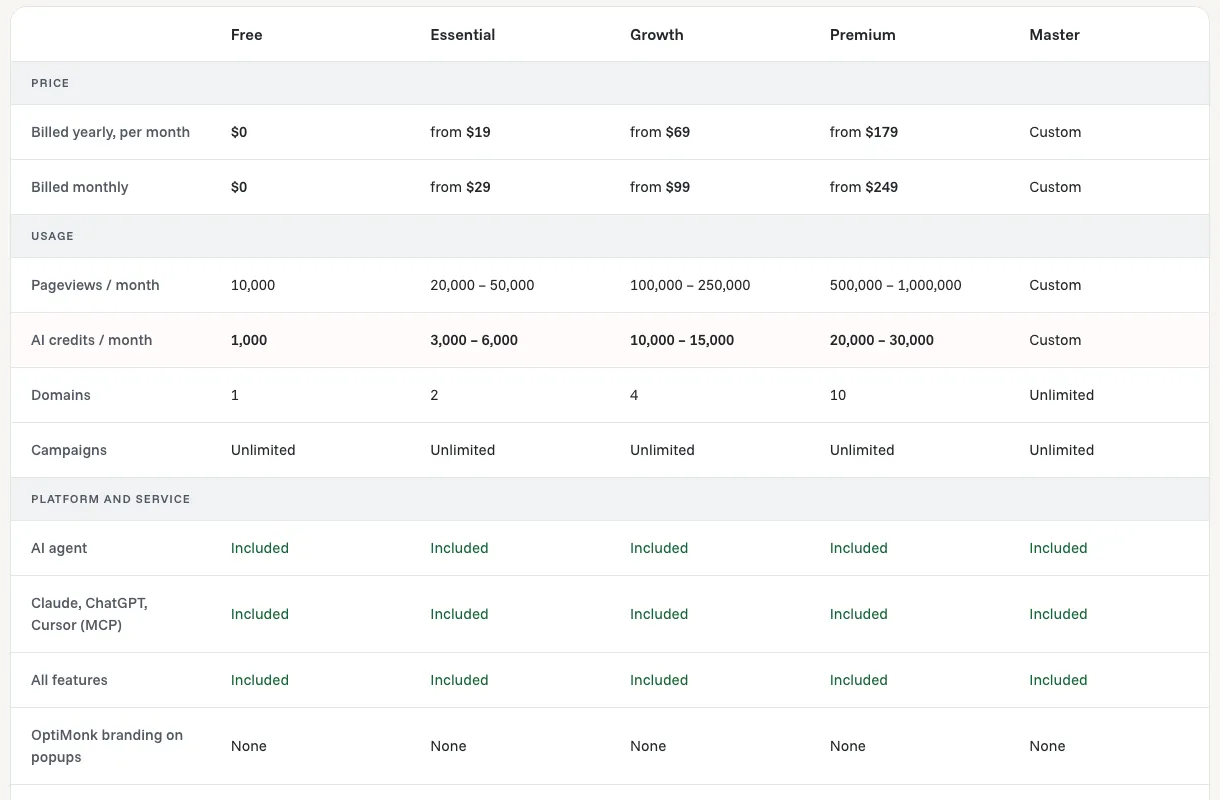
| Plan | Monthly | Annual (per mo) | Pageviews/mo | AI credits/mo | Domains |
|---|---|---|---|---|---|
| Free | $0 | $0 | 10,000 | 1,000 | 1 |
| Essential | from $29 | from $19 | 20,000-50,000 | 3,000-6,000 | 2 |
| Growth | from $99 | from $69 | 100,000-250,000 | 10,000-15,000 | 4 |
| Premium | from $249 | from $179 | 500,000-1,000,000 | 20,000-30,000 | 10 |
| Master | Custom | Custom | Above 1,000,000 | Custom | Unlimited |
Free doesn’t expire and doesn’t ask for a credit card, which OptiMonk’s pricing page treats as its de facto trial. Every plan, including Free, carries unlimited campaigns and the same core feature set: A/B testing, the full targeting list, every integration, live chat support and no OptiMonk branding on published widgets. OptiMonk told us that pageviews are the only real difference between plans, and the public pricing page backs that up for the core popup-building features; a separate OptiMonk comparison page against OptinMonster makes the same claim directly. What sits next to that claim on the pricing page tells a fuller story: domains scale from 1 on Free to unlimited on Master, AI credits scale alongside pageviews, and Premium and Master are the only tiers that add a dedicated key account manager. So “only pageviews differ” holds for the popup features themselves, not for the full list of what a buyer is paying for.
Each plan’s pageview figure is a range, not a single number. Essential, for example, covers 20,000 to 50,000 pageviews under the same “from $19/mo” headline price. The sticker price is a floor, and the actual monthly cost at a specific traffic level needs a check in the plan’s own selector rather than the headline number alone.
What happens at the pageview limit
OptiMonk emails a warning once a site crosses 80% of its plan’s pageview allowance, giving time to upgrade before hitting the ceiling. At 100%, campaigns pause rather than keep running on an automatic overage charge. They start again the moment the account upgrades to a higher tier, or automatically once the monthly pageview counter resets, whichever comes first. That second part matters: a site that spikes once, a product launch or a press mention, and then returns to normal traffic doesn’t need to pay more going forward, just ride out the pause until the counter resets. One thing isn’t published on any OptiMonk page this review could find: whether an account that upgrades mid-month and later drops back to Free still gets the “no credit card” treatment the Free plan advertises for brand-new signups.
What users say in reviews
 Trustpilot gives OptiMonk a 4.2 TrustScore from 46 reviews, 83% five-star and 15% one-star, with almost nothing in between. The five-star reviews single out the editor and support: one reviewer calls the form builder “super easy to use to make great looking forms” backed by support that’s “top-notch,” another credits the team for patiently walking through campaign setup, a third calls it “a fantastic tool” that’s “easy to use, effective, and backed by great support.” The one-star cluster tells a sharper story about billing: one reviewer says OptiMonk “has been charging us blind for over 2 years without issuing any invoices” and that repeated refund requests were met with an offer of three free months instead of money back; another says the company “refused to pay us back” more than $800 charged for a service they couldn’t use. Forty-six reviews is a small sample next to the 30,000 brands OptiMonk’s own homepage claims, so treat the rating as directionally useful rather than exhaustive.
The  Shopify App Store tells a more one-sided story: 4.8 out of 5 from 456 reviews, 92% five-star. Reviewers there praise the dashboard metrics, template designs and ease of editing and launching campaigns, and Shopify’s own review summary credits OptiMonk’s exit-intent and coupon popups for real conversion lift and calls support “exceptionally helpful.”
 G2’s listing shows OptiMonk at around 4.8 out of 5 from roughly 158 reviews (G2), with recurring themes about ease of use and template variety, alongside complaints that pageview-based pricing gets expensive once a site is large and that setup can be difficult for complex or high-traffic stores.
 Capterra’s listing shows a similar 4.9 out of 5 from about 22 reviews (Capterra).
Who should skip it
OptiMonk is a weaker fit for a site with unpredictable, spiky traffic and a tight budget: a single viral moment can push pageviews past a plan’s range and force a choice between a pause and an upgrade, even if the spike never converts as well as normal traffic. It’s also not the right pick for anyone who still wants to build new sidemessage, sticky bar or embedded campaigns, since the current AI-driven builder only creates popups, fullscreen overlays, gamified widgets and surveys; those older formats keep running on existing accounts but can’t be newly built. Teams that want landing pages and quizzes alongside popups, rather than popups as the main unit, are better served by ConvertFlow, which bills by funnel views instead of total site pageviews and bundles quizzes and personalized landing pages into the same builder. And given the Trustpilot pattern of billing complaints, anyone signing up for an annual plan should screenshot the plan terms and set a calendar reminder before the renewal date, not after.
Pricing note: Free costs $0 forever: 10,000 pageviews a month, 1,000 AI credits, 1 domain, unlimited campaigns, no credit card and no expiration date. Essential starts from $29/mo billed monthly, or $19/mo billed annually, covering a 20,000-50,000 pageview range with 3,000-6,000 AI credits and 2 domains. Growth starts from $99/mo monthly ($69/mo annually) for 100,000-250,000 pageviews, 10,000-15,000 AI credits and 4 domains. Premium starts from $249/mo monthly ($179/mo annually) for 500,000-1,000,000 pageviews, 20,000-30,000 AI credits, 10 domains, and adds a dedicated account manager. Master is custom pricing for sites above 1,000,000 pageviews a month, with unlimited domains. The pricing page shows each plan's pageview figure as a range rather than one fixed number, so the exact price for a given traffic level needs to be checked in the plan selector on optimonk.com/pricing, not assumed from the headline 'from' price. Hit the pageview ceiling and campaigns pause rather than trigger a surprise bill: OptiMonk emails a warning at 80% of the limit, then pauses campaigns at the limit itself until the account upgrades or the monthly counter resets, with no automatic overage billing in between.
Frequently asked questions
How much does OptiMonk cost?
Free costs $0/mo for 10,000 pageviews, 1,000 AI credits and 1 domain, no card needed. Essential starts from $29/mo billed monthly, or $19/mo billed annually, for a 20,000 to 50,000 pageview range and 2 domains. Growth starts from $99/mo monthly ($69/mo annually) for 100,000 to 250,000 pageviews and 4 domains. Premium starts from $249/mo monthly ($179/mo annually) for 500,000 to 1,000,000 pageviews, 10 domains and a dedicated account manager. Master is custom pricing for sites above 1,000,000 pageviews a month. Each plan's pageview figure is shown as a range on the pricing page, not a fixed number, so check the plan selector for the exact price at your traffic level.
Does OptiMonk have a free plan?
Yes. Free covers 10,000 pageviews and 1,000 AI credits a month on 1 domain, with unlimited campaigns, no credit card, and no expiration date. OptiMonk's own pricing page calls the Free plan its de facto trial rather than running a separate time-boxed trial.
What happens when you go over your OptiMonk pageview limit?
OptiMonk sends a warning email once a site reaches 80% of its plan's pageview allowance. At the limit itself, campaigns pause instead of generating an automatic overage charge. They start running again as soon as the account upgrades to a higher tier, or automatically once the monthly pageview counter resets, whichever happens first, so a one-time traffic spike doesn't automatically require paying for a permanently larger plan.
OptiMonk vs OptinMonster: which is cheaper?
OptinMonster's entry-level Basic plan lists at $9/mo for 2,500 campaign impressions, well below OptiMonk's $19/mo (billed annually) Essential plan starting at 20,000 pageviews. The two tools meter different things, though: OptinMonster bills by campaign impressions and states directly that it doesn't charge for website pageviews, while OptiMonk bills by pageviews across the whole site. OptiMonk's own comparison page also argues every feature is included at every tier, unlike OptinMonster's feature-gated plans. The same mismatch shows up elsewhere in the category: ConvertFlow bills by funnel views, counting only visitors who actually see a campaign, starting at $25/mo billed annually; Privy splits pricing across contacts, SMS credits and a separate pageview-based display tier starting at $24/mo; and Justuno and Poptin both bill by monthly visitors instead of pageviews. Comparing sticker prices alone is misleading. The real question is which metric matches your traffic pattern.
Bottom line
OptiMonk's free tier is real and its core popup features aren't gated behind paid tiers, which is unusual for the category. But a recurring Trustpilot pattern of unexplained charges and the gap between the 'only pageviews differ' pitch and the actual plan structure mean anyone picking a tier should read the plan selector closely before committing to annual billing.
Alternatives in Popup & CRO Tools

Popup and form builder with a separate email-automation ladder, priced by unique visitors instead of pageviews

No-code landing pages, popups and quizzes for on-site conversion

Popups, quizzes and on-site messaging for ecommerce, priced by pageviews with no public self-serve grid on the main site