

Quetext review
Plagiarism checker and AI content detector sharing one monthly word pool, with an AI humanizer bundled into both paid plans
Independent review. If you buy through links on this page we may earn a commission, at no extra cost to you. It never changes our scores — how we test.
ToolsGavel verdict
Quetext's case is its consistency: a plagiarism checker that third-party company profiles date to 2015, paired with an AI Detector that shares the same word pool, rated 4.6 to 4.8 out of 5 across Trustpilot, G2, Capterra and the Chrome Web Store, with no inflated accuracy percentage on its own marketing pages. The independent evidence behind that AI Detector is thin, a nine-sample CyberNews test at 65% accuracy and a two-sample test scoring close to a coin toss, nowhere near enough to call it settled either way. Billing and cancellation complaints are the dominant theme in Quetext's small share of one-star reviews, and the pricing page won't show an annual dollar figure even though it advertises a 40% discount. At $14.99 per 100,000 words on Essential, the cheapest paid plan, Quetext costs more than most other metered detectors in this guide, behind only Winston AI's un-discounted list price and Sapling's $25/mo month-to-month fee (Sapling billed annually, at $12/mo, comes in under Quetext); the plagiarism bundle and the consistent ratings are the trade-off for that higher per-word price.
Audited price: $14.99/mo month-to-month (advertised: $14.99/mo (Essential, 100,000 words/mo)) — verified 2026-10-31.
Best for: Writers and teams who want a plagiarism check and an AI check from the same scan, and who will treat a single AI-detector score as one signal rather than a verdict
What we liked
- Quetext is one of just two detectors in this comparison with a positive score across all four review platforms checked, and the tightest spread of the two: 4.6 on Trustpilot, 4.7 on G2, 4.6 on Capterra and 4.8 on the Chrome Web Store (Trustpilot; G2; Capterra; Chrome Web Store)
- Quetext's own marketing makes no quantified accuracy or false-positive claim, a more restrained pitch than detectors that lead with a 97% or 99% headline number (quetext.com/ai-content-detector, 2026-10-31)
- The plagiarism checker is Quetext's original product, running its own "DeepSearch" technology against what the company describes as billions of indexed sources, not a feature added onto a newer AI checker (quetext.com, 2026-10-31)
- Browser coverage runs wider than most of this category: official Chrome, Firefox and Edge extensions, plus a Quetext MCP connector for AI-assistant tool use (quetext.com, 2026-10-31)
- Essential and Professional both include API access and bulk upload (20 files and 100 files), with Professional adding unlimited team seats at no extra per-seat charge (quetext.com/pricing, 2026-10-31)
What to watch
- The only independent accuracy evidence found for Quetext's AI detector is a nine-sample CyberNews test that measured 65% overall accuracy, including one mostly-human passage scored 99.9% AI; a separate two-sample test scored an AI-rewrite at 49%, close to a coin toss. Neither sample is large enough to settle a real false-positive rate (cybernews.com/ai-tools/best-ai-detector, 2026-10-31)
- Billing and cancellation is the recurring complaint on Trustpilot's one- and two-star reviews, including a report of being charged twice within one week and another describing the cancellation process as impossible to complete (trustpilot.com/review/quetext.com, 2026-10-31)
- Quetext's pricing page advertises "40% off" annual billing but doesn't show the actual annual dollar figure, and third-party sources disagree on what it works out to, so there's no confirmed annual price to budget around (quetext.com/pricing, 2026-10-31)
- The AI Detector and Plagiarism Checker draw from the same word pool rather than separate allowances, so running both checks burns through the monthly allowance faster than a detector-only competitor's pricing implies (quetext.com/pricing, 2026-10-31)
How much does Quetext really cost?
| Advertised price | $14.99/mo (Essential, 100,000 words/mo) |
|---|---|
| Real monthly cost, billed annually | No flat rate published |
| Real monthly cost, month-to-month | $14.99/mo |
| The billing catch | Plagiarism and AI checks draw from one shared 100,000-word pool. Annual billing is advertised as "40% off" but the exact annual price is not shown. |
| Permanent free tier | Yes |
| Price last verified | 2026-10-31, against the live pricing page at quetext.com |
Model seats and billing cycles for Quetext in the true-cost calculator, or see every audited price in the Pricing Gap Index.
Price watch
Get an email if Quetext's price changes
We re-check Quetext's pricing on a schedule. If the price, the free plan or a verified deal changes, you get one short email. Nothing else.
Quetext pairs a plagiarism checker built on its own “DeepSearch” technology with an AI Detector that draws from the same monthly word pool, plus an AI Humanizer and Summarizer bundled into both paid plans. It’s one of the most consistently rated detectors in this guide, scoring in the 4.6-4.8 range on every platform we checked, Trustpilot, G2, Capterra and the Chrome Web Store, as of October 2026. Essential starts at $14.99/mo for a shared 100,000-word pool, higher than every other metered detector’s cheapest confirmed rate in this guide except Winston AI’s $18.00 list price and Sapling’s $25/mo month-to-month fee, and the independent evidence behind its AI Detector’s accuracy is thinner than the review scores might suggest.
What Quetext is for
Quetext’s core product, dating back to 2015, is a plagiarism checker running proprietary “DeepSearch” technology against what the company describes as billions of indexed web sources. The newer AI Detector sits in the same dashboard and draws on the same word pool, built to flag ChatGPT, GPT-5, Claude, Gemini, Llama and Mistral output using sentence-level scoring based on word predictability, sentence rhythm and structural repetition; Quetext doesn’t name a specific model architecture behind that scoring. Essential and Professional also bundle an AI Humanizer and an AI Summarizer; this review covers only the Plagiarism Checker and AI Detector and doesn’t evaluate the Humanizer. Browser extensions for Chrome, Firefox and Edge let a user highlight text inside Google Docs and scan it without copying and pasting, extension-based access rather than a native Docs add-on, and a Quetext MCP connector extends the same detection to AI-assistant tool use. The AI-detector product page lists 25 supported languages, though a separate marketing page elsewhere on the site says 16, an inconsistency we couldn’t resolve.
What you get on each plan
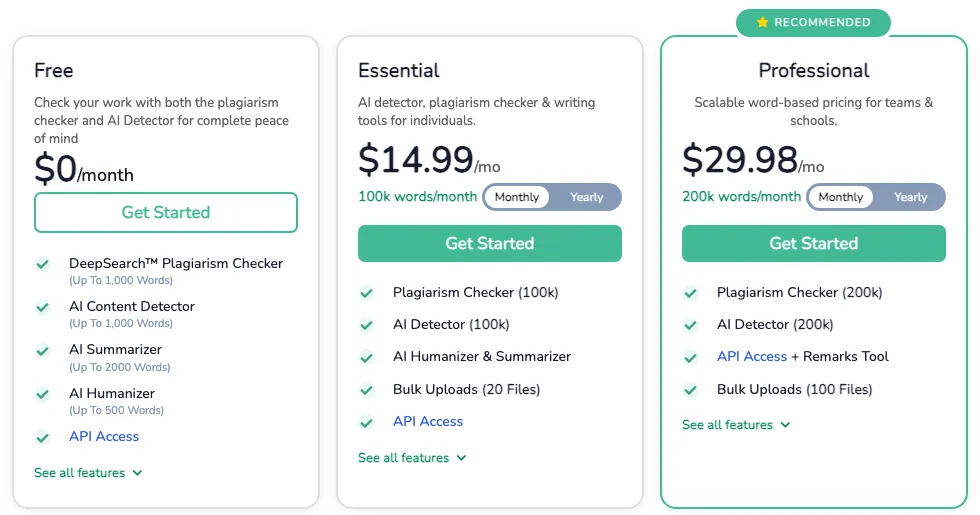
| Plan | Monthly | Annual | Word pool | Key features |
|---|---|---|---|---|
| Free | $0 | - | 1,000 words plagiarism, 1,000 words AI Detector, 2,000 words Summarizer, 500 words Humanizer | No card requirement stated either way |
| Essential | $14.99/mo | not confirmed (“40% off” advertised) | 100,000 words/mo, shared between Plagiarism Checker and AI Detector | 20-file bulk upload, API access, grammar/spell check, 25,000 words/mo AITutorMe, bundled Humanizer + Summarizer |
| Professional | $29.98/mo | not confirmed (“40% off” advertised) | 200,000 words/mo, same shared pool | 100-file bulk upload, API access, Remarks tool, unlimited team seats, 50,000 words/mo each of Summarizer, Humanizer and AITutorMe |
Checking 100,000 words on Essential costs $14.99, since the AI Detector can draw on the full shared pool rather than splitting it with the Plagiarism Checker. That’s higher than Originality.ai’s $6.48-$7.48 per 100,000 words and most other metered detectors in this guide, though Winston AI’s un-discounted list price ($18.00) and Sapling’s $25/mo month-to-month fee run higher still. Quetext doesn’t publish a per-word overage rate; the pricing page only says users can “purchase additional words” or upgrade tiers.
Accuracy evidence: thin on both sides
Quetext’s own site makes no quantified accuracy or false-positive claim for its AI Detector, a more restrained choice than competitors that lead with a 97% or 99% headline number. That restraint doesn’t mean the evidence is settled, just that there’s less marketing noise to wade through. The only independent test found is CyberNews’ nine-sample run (three human, three fully AI-generated, three AI-with-light-edits), which measured 65% overall accuracy and reported the detector “struggled with mixed content,” in one case scoring a mostly-human passage 99.9% AI. A second, two-sample test on Medium scored Quetext’s AI Detector 0% on a human sample and 49% on an AI-rewritten version of the same text, close to a coin toss; the author discloses an affiliate relationship with Quetext, so read it as independent but monetized, and too small a sample to generalize from either way. A separate 18% false-positive figure circulates in secondary coverage, attributed to “TwainGPT,” itself a competing AI-humanizer brand; that’s a competitor-sourced claim, not a neutral test, flagged here rather than reported as fact. No independent, large-sample false-positive study for Quetext exists as of October 2026. Combined with the broader category finding that detectors misflag non-native English writing at a 61.3% average rate (Stanford/Liang TOEFL study), that gap means a single Quetext score shouldn’t be the only evidence behind a decision.
What users say in reviews
Quetext is one of just two detectors in this comparison with a positive score on every platform we checked, and the tighter of the two:  Trustpilot rates it 4.6 out of 5 from 154 reviews (though only 6 of those are from the last 12 months),
 G2 rates it 4.7 out of 5 from 13 reviews,
 Capterra rates it 4.6 out of 5 from 10 reviews (4.9 for ease of use, 4.8 for customer service), and its Chrome extension sits at 4.8 out of 5 from 16 ratings and roughly 8,000 users. That’s a stronger, more consistent spread than most of this category, but the small, mostly negative minority tells its own story. Trustpilot’s one- and two-star reviews repeat a billing and cancellation theme: one reviewer describes the cancellation process as impossible to complete, another reports being charged twice within one week, and a third describes being told a document scored 22% AI but never receiving the report, requiring three separate runs of the same text. A smaller complaint thread describes unused word credits expiring if the account goes unused for a stretch, a metering-model complaint rather than a reliability one.
Who should skip it
Quetext is a weak fit for anyone who wants a confirmed annual price before committing; the “40% off” discount is advertised, but the actual dollar figure isn’t shown on the live pricing page, and secondary sources disagree on what it works out to. Anyone running heavy plagiarism and AI-detection volume in the same month should also budget carefully, since both features draw from one shared word pool rather than separate allowances. A team that wants a wider published language count on the AI-detection side, or a Canvas LMS integration confirmed as live rather than conflicting across the vendor’s own marketing pages, should compare Copyleaks instead. Anyone who needs to check images and documents as well as text should read TruthScan, though its own independent accuracy evidence carries its own caveats. See the full comparison, including GPTZero and Winston AI, in Best AI Detectors.
Pricing note: Quetext's Free plan gives 1,000 words for the Plagiarism Checker and 1,000 words for the AI Detector each month, plus 2,000 words for the Summarizer and 500 words for the Humanizer; the pricing page doesn't state whether that allowance refills monthly or is a one-time amount, and there's no stated card requirement either way. Essential runs $14.99/mo for a 100,000-word pool that the Plagiarism Checker and AI Detector draw from together rather than each getting its own allowance, plus 20-file bulk upload, API access, grammar and spell check, 25,000 words/mo of "AITutorMe," and the bundled AI Humanizer and Summarizer. Professional runs $29.98/mo for a 200,000-word pool on the same shared structure, adding 100-file bulk upload, a Remarks tool, unlimited team seats, and 50,000 words/mo each of Summarizer, Humanizer and AITutorMe. The pricing page advertises "40% off" for annual billing, but the dollar figure isn't shown on the live page, and secondary sources disagree on what that works out to, so this review sticks to the confirmed monthly prices. Checking 100,000 words on Essential, the cheapest paid plan, costs $14.99, since the AI Detector can draw on the full shared pool (quetext.com/pricing, checked 2026-10-31).
Frequently asked questions
How much does Quetext cost?
Essential runs $14.99/mo for a 100,000-word pool shared between the Plagiarism Checker and the AI Detector, working out to $14.99 per 100,000 words if the whole allowance goes to the AI check. Professional runs $29.98/mo for a 200,000-word pool on the same shared structure. Quetext's pricing page advertises "40% off" for annual billing, but the actual dollar figure isn't shown on the live page, and secondary sources disagree on what it works out to, so we can't publish a confirmed annual price (quetext.com/pricing).
Does Quetext include a plagiarism checker as well as AI detection?
Yes, and it's Quetext's original product, which third-party company profiles date to 2015, running its own "DeepSearch" technology against what the company describes as billions of indexed web sources. The catch is that the Plagiarism Checker and AI Detector draw from the same monthly word pool rather than each getting its own allowance, so heavy use of one leaves less budget for the other.
Is Quetext's plan bundled with an AI humanizer?
Yes. Essential and Professional both include an AI Humanizer and an AI Summarizer alongside the Plagiarism Checker and AI Detector, and the Free plan includes 500 words of Humanizer use. This review covers only the plagiarism and AI-detection side and doesn't evaluate the Humanizer.
How accurate is Quetext at detecting AI-generated text?
There's no large-sample independent test to answer that with confidence. The only independent evidence found is a nine-sample CyberNews test that measured 65% overall accuracy, including one mostly-human passage scored 99.9% AI, and a two-sample Medium test that scored an AI-rewrite at 49%, close to a coin toss. Quetext's own site doesn't publish a quantified accuracy claim, which is unusual for this category but doesn't substitute for the large-sample independent test that doesn't yet exist.
Does Quetext have a free plan?
Yes. Free gives 1,000 words for the Plagiarism Checker and 1,000 words for the AI Detector, plus 2,000 words for the Summarizer and 500 words for the Humanizer. The pricing page doesn't say whether that allowance refills every month or is a one-time amount, unlike the paid tiers, which explicitly state a monthly allowance.
Bottom line
Quetext's case is its consistency: a plagiarism checker that third-party company profiles date to 2015, paired with an AI Detector that shares the same word pool, rated 4.6 to 4.8 out of 5 across Trustpilot, G2, Capterra and the Chrome Web Store, with no inflated accuracy percentage on its own marketing pages. The independent evidence behind that AI Detector is thin, a nine-sample CyberNews test at 65% accuracy and a two-sample test scoring close to a coin toss, nowhere near enough to call it settled either way. Billing and cancellation complaints are the dominant theme in Quetext's small share of one-star reviews, and the pricing page won't show an annual dollar figure even though it advertises a 40% discount. At $14.99 per 100,000 words on Essential, the cheapest paid plan, Quetext costs more than most other metered detectors in this guide, behind only Winston AI's un-discounted list price and Sapling's $25/mo month-to-month fee (Sapling billed annually, at $12/mo, comes in under Quetext); the plagiarism bundle and the consistent ratings are the trade-off for that higher per-word price.
Alternatives in AI Content Detectors

AI content detector bundled with plagiarism, grammar and fact-checking, priced by a monthly word allowance

AI content detector with a monthly free word allowance, priced on volume at a rate the vendor only publishes billed annually

AI and image detector with OCR bundled in, priced through a promo code that doubles the bill if it ever stops working