

Airtable review
The category-defining spreadsheet-database hybrid, now owned by Bending Spoons after a $1.285 billion acquisition
Independent review. If you buy through links on this page we may earn a commission, at no extra cost to you. It never changes our scores — how we test.
ToolsGavel verdict
Airtable is still the deepest, best-connected no-code database on the market, and its free tier is one of the few that supports a real first project. But per-seat pricing is the dominant complaint behind its 2.0 Trustpilot score, and the Bending Spoons acquisition, closed in September 2026 and followed five weeks later by large staff departures, is a live reason to expect price or support changes over the next year or two rather than a remote one.
Audited price: $20/mo billed annually , $24/mo month-to-month (advertised: $20/mo (Team, billed annually)) — verified 2026-10-30.
Best for: Teams that want the deepest database and the broadest app ecosystem, and are willing to track Bending Spoons' next move on price and staffing
What we liked
- The category-defining product by review volume and ecosystem size: 4.6 out of 5 on G2 from 3,303 reviews and 4.6 out of 5 on Capterra from 2,250 reviews, the largest combined sample of any tool in this guide (G2 / Capterra)
- A free plan that holds up for a real first project: 1,000 records, 5 editors, and unlimited free viewers and form respondents, no credit card required (airtable.com/pricing)
- Interface Designer builds a lightweight internal dashboard directly on top of base data, so a simple internal tool doesn't need a separate app builder bolted on (airtable.com)
- A large third-party ecosystem, 654-plus technology and channel partnerships, including purpose-built app layers like Softr that run directly on top of an Airtable base (airtable.com)
What to watch
- Per-seat pricing is the single dominant complaint in this entire category: adding one collaborator with edit access silently adds a paid seat, and it's the root cause behind a Trustpilot score of just 2.0 out of 5, where 61% of all reviews are one star (Trustpilot)
- The Team-to-Business jump is a 125% per-seat price increase with no intermediate tier, landing right at the point a base outgrows the 50,000-record Team ceiling (airtable.com/pricing)
- Airtable was acquired by Bending Spoons in a deal that closed September 4, 2026, and five weeks later, on October 12, the new product lead announced the company was 'parting ways with a large portion' of its pre-acquisition staff; Bending Spoons raised Evernote's personal annual price 86% within about two years of acquiring it and cut 75% of WeTransfer's staff within weeks of that deal closing (businesswire.com / noloco.io)
- Reviewers report billing that continues after cancellation and slow support response (Trustpilot)
How much does Airtable really cost?
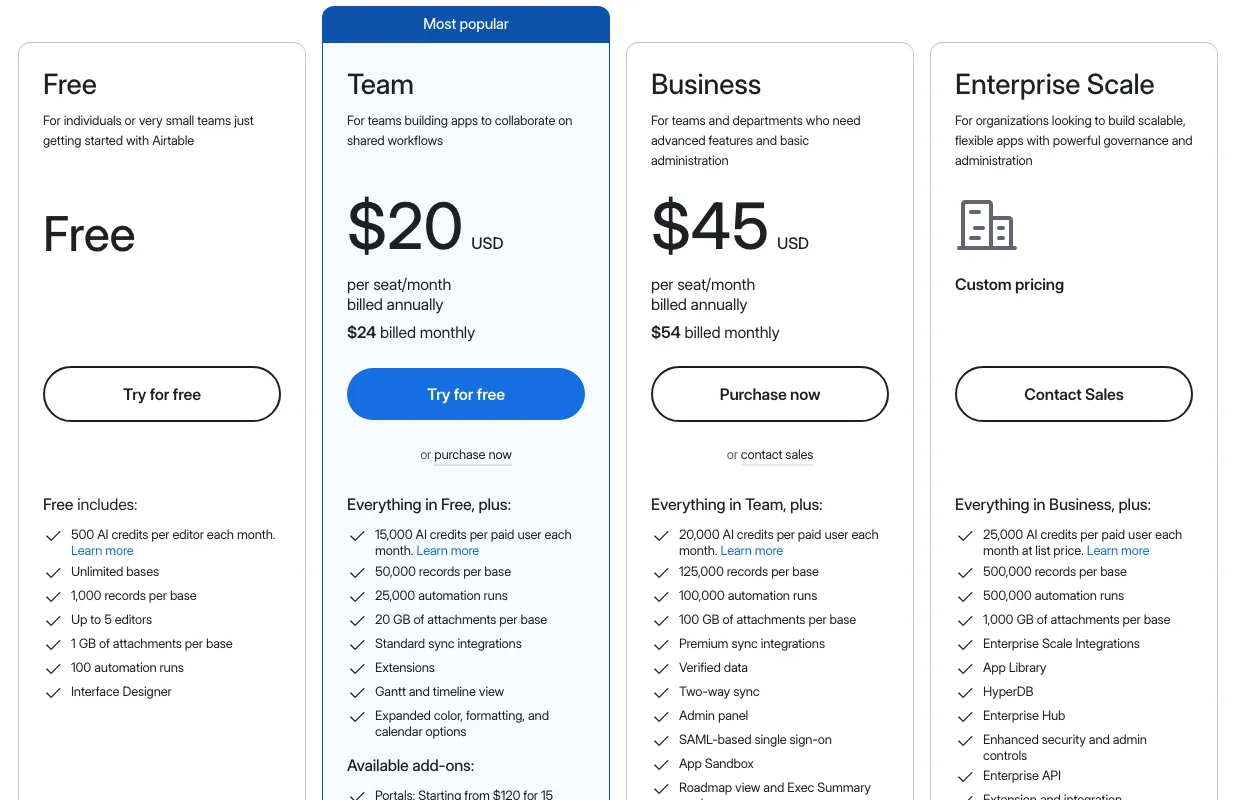
| Advertised price | $20/mo (Team, billed annually) |
|---|---|
| Real monthly cost, billed annually | $20/mo |
| Real monthly cost, month-to-month | $24/mo |
| Month-to-month premium | +20% over the annual-billing rate |
| The billing catch | Billed monthly jumps to $24/mo (+20%), and outgrowing Team's 50,000-record cap forces a 125% per-seat jump to Business, with no tier in between. |
| Permanent free tier | Yes |
| Price last verified | 2026-10-30, against the live pricing page at airtable.com |
Model seats and billing cycles for Airtable in the true-cost calculator, or see every audited price in the Pricing Gap Index.
Price watch
Get an email if Airtable's price changes
We re-check Airtable's pricing on a schedule. If the price, the free plan or a verified deal changes, you get one short email. Nothing else.
Airtable is a spreadsheet-database hybrid that lets a team build grid, kanban, calendar, gallery and form views over a relational-ish set of records, backed by native automations and a growing AI layer. It’s also the database Softr is most often built on top of. Pricing runs free for a small base, then $24 to $54 a month per seat before volume discounts, and the company changed hands in September 2026: Bending Spoons, the Nasdaq-listed Italian app conglomerate behind Evernote and WeTransfer, closed a $1.285 billion cash acquisition of Airtable on September 4. G2 rates it 4.6 out of 5 from 3,303 reviews and Capterra 4.6 out of 5 from 2,250 reviews, the largest sample of any tool in this guide. Trustpilot tells a different story: 2.0 out of 5 from 159 reviews.
What Airtable is for
Each base behaves like a spreadsheet with a database underneath it: fields have real types (linked records, lookups, rollups, attachments), and the same data renders as a grid, kanban board, calendar or gallery without re-entering anything. Interface Designer sits on top of a base and builds a lightweight internal dashboard, enough for simple ops tools without reaching for a separate app builder. Automations handle the usual triggers and actions, and Airtable’s AI layer has grown out from there. Airtable also counts 654-plus technology and channel partnerships, which is why purpose-built app layers like Softr exist to sit on top of an Airtable base rather than replace it.
What you get on each plan
| Plan | Monthly | Annual (per seat/mo) | Records/base | Automation runs/mo | API calls/mo |
|---|---|---|---|---|---|
| Free | $0 | $0 | 1,000 | 100 | 1,000 |
| Team | $24 | $20 | 50,000 | 25,000 | 100,000 |
| Business | $54 | $45 | 125,000 | 100,000 | Unlimited |
| Enterprise Scale | Custom | Custom | 500,000+ | 500,000+ | Unlimited |
Airtable charges per editor seat, meaning anyone with edit permission on at least one base, not by total users. Viewers, form submitters and share-link visitors stay free and uncapped on Team and Business. Free caps out at 5 editors. The structural catch sits between Team and Business: moving from a $20 to a $45 per-seat monthly rate, with no step in between, is a 125% jump, and it lands exactly when a base crosses 50,000 records, a ceiling real usage tends to hit sooner than the headline pricing suggests.
The Bending Spoons acquisition, and why it matters for buyers
This is the fact that should shape how you read every other number on this page. Bending Spoons signed the deal to buy Airtable on August 4, 2026, and closed it a month later, on September 4. Five weeks after that, on October 12, Airtable’s new product lead, a Bending Spoons appointee, announced the company was parting ways with a large portion of its pre-acquisition team.
Bending Spoons has done this before, and the pattern is public record, not speculation. It acquired Evernote in late 2022 and, within about two years, raised the price of a personal annual plan from $69.99 to $129.99, an 86% increase. Later, in November 2025, it introduced storage limits that had never existed on the product before and pushed power users toward a new $250-a-year tier. It acquired WeTransfer in mid-2024 and cut 75% of its staff within weeks, then capped free-tier transfers shortly after. Neither move was hidden; both are documented across multiple independent sources as the same acquire-then-monetize sequence.
None of this means Airtable’s current pricing or support changes tomorrow. The plans and limits in the table above are accurate as of October 30, 2026. It does mean a buyer should budget for the possibility of a price increase, a feature cut or a support slowdown sometime in the next year or two, the way Evernote and WeTransfer customers eventually had to, rather than treating today’s Airtable as a locked-in long-term default.
What users say in reviews
The gap between Airtable’s review platforms is the clearest signal in this guide.  G2 (4.6/5, 3,303 reviews) and
 Capterra (4.6/5, 2,250 reviews) both reflect a large, satisfied user base evaluating the product on capability.
 Trustpilot (2.0/5, 159 reviews) reflects something narrower and angrier: 61% of its reviews are one star, and the complaints cluster tightly around per-seat billing, the Team-to-Business price jump, slow support response, and billing that continues after a cancellation request. That’s not a scattered set of unrelated gripes. It’s one root cause, seat-based pricing, showing up across several related complaints.
Who should skip it
Airtable is a weak fit for a team that needs several editors rather than mostly viewers; the per-seat cost compounds faster than most buyers expect once past 5 or 6 active editors. A team that’s already decided per-seat pricing is the wrong model should look at Knack instead, which charges by records and storage with unlimited users on every tier. A team that wants Airtable’s database depth but zero acquisition risk should weigh Baserow, the only self-hosted, open-source option in this guide. For a side-by-side of all four, see Best No-Code App Builders and Databases. Anyone who wants to put a real client-facing app or portal on top of an Airtable base, rather than relying on Interface Designer alone, should read the Softr review next.
Pricing note: Airtable has four plans, billed per editor seat rather than by total records alone. Free costs $0 forever: 1,000 records per base, 5 editors, and unlimited free viewers, form submitters and share-link visitors, no card required. Team runs $24/mo billed monthly or $20/mo billed annually ($240/yr per seat) for 50,000 records per base, 25,000 automation runs a month and 100,000 API calls a month. Business runs $54/mo monthly or $45/mo annually ($540/yr per seat) for 125,000 records, 100,000 automation runs and unlimited API calls. Enterprise Scale is custom priced, built around 500,000 or more records and automation runs as reference points. The jump from Team to Business is a 125% per-seat price increase with no plan in between, which becomes a real problem the moment a base crosses the 50,000-record Team ceiling. Nonprofit and education discounts are available, and Business and Enterprise customers can pay by invoice (PO, ACH, wire or check) instead of a card.
Frequently asked questions
How much does Airtable cost?
Airtable has four plans. Free costs $0 forever for 1,000 records per base, 5 editors and unlimited free viewers and form respondents. Team runs $24/mo billed monthly or $20/mo billed annually for 50,000 records, 25,000 automation runs a month and 100,000 API calls a month. Business runs $54/mo monthly or $45/mo annually for 125,000 records, 100,000 automation runs and unlimited API calls. Enterprise Scale is custom priced. Pricing is per editor seat, not per total user, and the Team-to-Business jump is a 125% per-seat increase with no tier in between.
Does Airtable have a free plan?
Yes, and it doesn't expire or require a card. Free covers 1,000 records per base, 5 editors, and unlimited free viewers, form submitters and share-link visitors. The cap that usually forces an upgrade is editors, not viewers: once a sixth person needs edit access, the base needs a paid plan.
Who owns Airtable now, and why does it matter?
Bending Spoons, a Nasdaq-listed Italian app conglomerate, closed a $1.285 billion cash acquisition of Airtable on September 4, 2026. Five weeks later, on October 12, Airtable's new product lead announced the company was parting ways with a large portion of its pre-acquisition team. Bending Spoons has a documented pattern at other acquisitions: it raised Evernote's personal annual price 86% (from $69.99 to $129.99) within about two years of buying it, and cut 75% of WeTransfer's staff within weeks of that acquisition closing. Airtable's current pricing and support are unchanged as of this review, but that history is a reason to budget for possible changes over the next year or two, not a hypothetical one.
Why is Airtable's Trustpilot score so much lower than its G2 or Capterra score?
G2 (4.6/5, 3,303 reviews) and Capterra (4.6/5, 2,250 reviews) reflect a large user base evaluating capability. Trustpilot (2.0/5, 159 reviews) skews toward billing disputes: 61% of its reviews are one star, concentrated on per-seat pricing surprises, the Team-to-Business price jump, slow support, and billing that continues after a cancellation request.
What's the difference between Airtable and Softr?
Airtable is the database: it stores the records, views and automations. Softr is an app layer that renders a client portal or internal tool on top of a data source, most often an Airtable base, though it can also run on Google Sheets or its own native database. A team usually needs Airtable first and adds Softr when it needs to hand a permissioned app to someone outside the team. See the full Softr review.
Bottom line
Airtable is still the deepest, best-connected no-code database on the market, and its free tier is one of the few that supports a real first project. But per-seat pricing is the dominant complaint behind its 2.0 Trustpilot score, and the Bending Spoons acquisition, closed in September 2026 and followed five weeks later by large staff departures, is a live reason to expect price or support changes over the next year or two rather than a remote one.
Alternatives in No-Code App Builders & Databases

A no-code app layer that turns an Airtable base, a Google Sheet or its own database into a client portal or internal tool

A no-code database and app builder that charges by records and storage, with unlimited users on every plan

An open-source, Airtable-style database that's free and unlimited when you self-host it