

Softr review
A no-code app layer that turns an Airtable base, a Google Sheet or its own database into a client portal or internal tool
Independent review. If you buy through links on this page we may earn a commission, at no extra cost to you. It never changes our scores — how we test.
ToolsGavel verdict
Softr is the clearest no-code choice in this guide for a buyer who wants a client portal or internal tool on top of existing data, backed by a 4.7 G2 score across a real sample size. The catch is a three-meter pricing system, records, workflow actions and seats, that multiple reviewers say is genuinely hard to track, plus per-seat add-on costs that push real team pricing above the sticker number.
Audited price: $19/mo billed annually , $25/mo month-to-month (advertised: $19/mo (Basic, billed annually)) — verified 2026-10-30.
Best for: Teams that already have (or want) structured data in Airtable, Google Sheets or Softr's native database and need a client portal or internal app built on top without hiring a developer
What we liked
- Purpose-built as the app layer over Airtable, Google Sheets or native data, the clearest positioning in this guide for a buyer who wants a real client portal or internal tool without hiring a developer (softr.io)
- A strong G2 score at real scale: 4.7 out of 5 across 749 reviews, and 4.7 out of 5 on Capterra across 64 reviews, among the highest-rated tools in this guide (G2 / Capterra)
- A free tier generous enough to test a real small-business app idea before paying: 5,000 records, 3 builders and 500 workflow actions a month (softr.io)
- Native mobile app publishing, plus an AI app-builder layer added in 2026, cut down on how often a separate tool is needed (softr.io)
What to watch
- Three separate meters stacked on every plan, records, workflow actions and seats, are genuinely harder to forecast than a single-unit competitor; one reviewer called the system 'extremely difficult to monitor or manage' (G2/Capterra/Product Hunt synthesis)
- Performance degrades on large underlying Airtable bases, and theming is limited enough that global style changes sometimes require per-object edits (Capterra/Software Advice synthesis)
- Extra builder seats cost $6 to $24 a month each on top of the plan price, which pushes real team cost above the headline number once more than one or two people need to build (softr.io)
- Pricing was restructured as recently as August 2026, so a plan quoted months ago may already be out of date (javisreview.com)
How much does Softr really cost?
| Advertised price | $19/mo (Basic, billed annually) |
|---|---|
| Real monthly cost, billed annually | $19/mo |
| Real monthly cost, month-to-month | $25/mo |
| Month-to-month premium | +32% over the annual-billing rate |
| The billing catch | Billed monthly jumps to $25/mo (+32%), and extra builder seats beyond the plan's included count cost $6/mo each on top of the base price. |
| Permanent free tier | Yes |
| Price last verified | 2026-10-30, against the live pricing page at softr.io |
Model seats and billing cycles for Softr in the true-cost calculator, or see every audited price in the Pricing Gap Index.
Price watch
Get an email if Softr's price changes
We re-check Softr's pricing on a schedule. If the price, the free plan or a verified deal changes, you get one short email. Nothing else.
Softr builds client portals, internal tools and member sites on top of data you already have, in Airtable, Google Sheets or Softr’s own native database, aimed at a buyer who wants a real app experience without hiring a developer. Pricing runs free for a small project, then $25 to $395 a month across three published paid tiers, metered on three separate counters at once: records, workflow actions and seats. G2 rates it 4.7 out of 5 from 749 reviews and Capterra 4.7 out of 5 from 64 reviews, among the strongest scores of any tool in this guide.
What Softr is for
Softr doesn’t store your data by default. It renders an app on top of whatever already holds it, an Airtable base, a Google Sheet, or Softr’s own native database for a team that doesn’t have either yet. A builder picks pre-made blocks (lists, profile pages, forms, member logins, payment gates) and wires them to fields in the underlying data source, which is faster than coding a portal from scratch but still produces a real, permissioned, client-facing app rather than a shared spreadsheet view. Softr added an AI App Builder and a generative “vibe coding” layer in 2026, plus native mobile app publishing on some tiers, and runs a separate paid Partner Program for agencies building client work on top of it, distinct from its affiliate program.
How Softr works with Airtable (and other data sources)
The most common Softr setup pairs it with an Airtable base: Airtable holds the records, views and automations, and Softr turns that base into something an end user who isn’t on your team can actually log into, a client portal, a directory, a booking app, a membership site. The two tools solve different problems. Airtable is the database and internal workspace; Softr is the permissioned front end a client or customer sees. Swapping in Google Sheets or Softr’s native database instead works the same way, so the combination isn’t locked to any one backend.
That pairing carries a dependency worth naming given Airtable’s 2026 ownership change. If a Softr app’s data lives in an Airtable base, a future Airtable price increase, API change or feature cut, the kind of move Bending Spoons has made before at Evernote and WeTransfer, flows straight through to the Softr app built on top of it. That’s not a reason to avoid the combination today; Airtable remains the most capable backend most Softr builders will choose. It is a reason to pick a backend deliberately rather than by default, and to know that Softr’s native database or Google Sheets are real fallback options if Airtable’s terms change in a way that matters to your app.
What you get on each plan
| Plan | Monthly | Annual (effective/mo) | DB records | Workflow actions/mo | Builders / Team users / Client users |
|---|---|---|---|---|---|
| Free | $0 | $0 | 5,000 | 500 | 3 builders / 5 app users / 5 AI credits/mo |
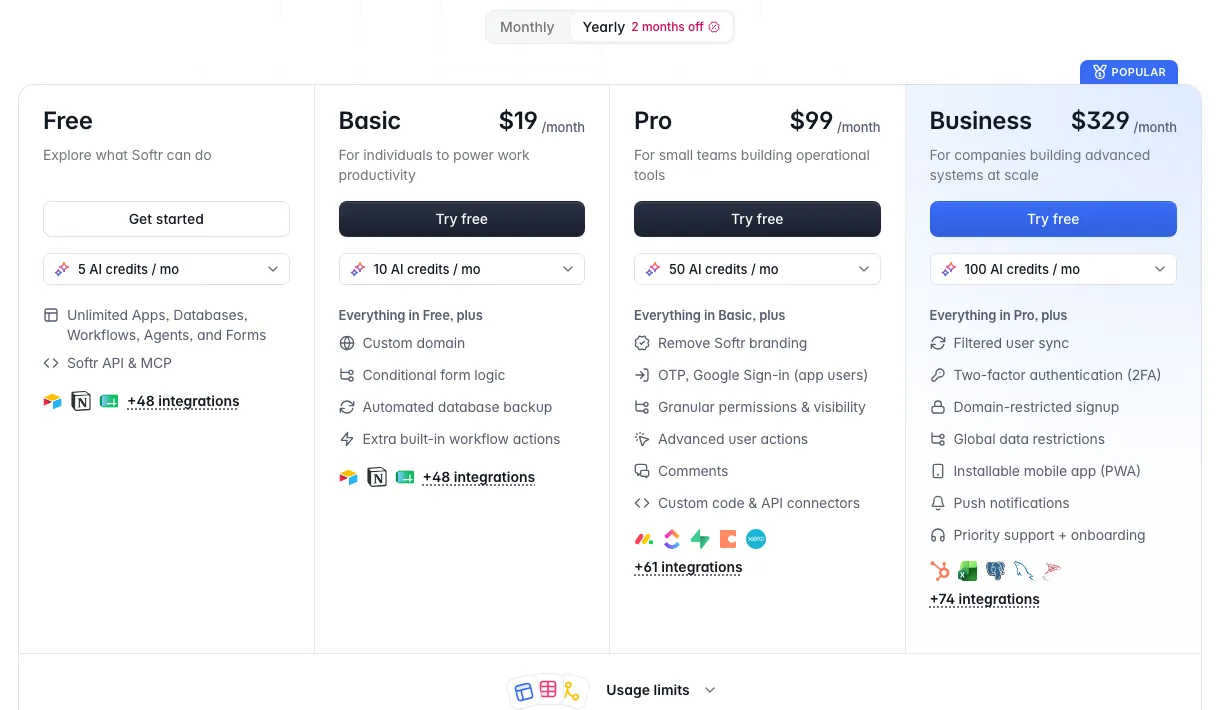
| Basic | $25 | $19 ($228/yr) | 50,000 | 2,500 | 1 builder / 5 team users / 5 client users |
| Pro | $119 | $99 ($1,188/yr) | 500,000 | 10,000 | 2 builders / 10 team users / 50 client users |
| Business | $395 | $329 ($3,948/yr) | 1,000,000 | 25,000 | 3 builders / 30 team users / 100 client users |
The catch sits in how those three numbers move independently of each other. A team can run out of workflow actions well before it runs out of records, or need a fourth builder seat before it needs more client users, and each overage behaves differently: workflow actions pause until the next cycle or an upgrade, with no per-action overage charge, while behavior at the record ceiling itself isn’t independently confirmed. Extra builder seats, not covered by any plan’s included count, cost $6 a month on Basic, $12 on Pro and $24 on Business, a real add-on cost once more than one or two people need builder access.
What users say in reviews
Softr’s review profile skews positive and consistent:  G2’s 4.7 from 749 reviews and
 Capterra’s 4.7 from 64 reviews both land near the top of this guide, with roughly 84% five-star and about 12% one-star across the negative-review synthesis. The one-star cluster has a clear throughline: the three-meter system (records, workflow actions, seats) is hard to monitor, and one reviewer put it bluntly as “extremely difficult to monitor or manage.” Performance on large underlying Airtable bases and theming limits show up repeatedly once an app grows past a simple MVP, and a minority of reviewers mention slow support during a launch.
 Trustpilot wasn’t independently checked for Softr this round, so this review doesn’t cite a Trustpilot score the way it does for Airtable.
Who should skip it
Softr is a weak fit for a team whose real need is the database itself rather than a portal on top of one; Airtable or Baserow are the better starting point if there’s no end-user-facing app to build yet. A team that wants to avoid per-seat and multi-meter pricing altogether should compare Knack, which charges by records and storage with unlimited users on every tier. See the full four-way comparison in Best No-Code App Builders and Databases.
Pricing note: Softr has three published paid plans plus custom Enterprise, metered on three separate counters at once: database records, monthly workflow actions, and builder/team-user/client-user seats. Free costs $0: 5,000 records, 500 workflow actions a month, 3 builders, 5 app users and 5 AI credits a month. Basic runs $25/mo billed monthly or $19/mo billed annually ($228/yr) for 50,000 records, 2,500 workflow actions a month, 1 builder, 5 team users and 5 client users. Pro runs $119/mo monthly or $99/mo annually ($1,188/yr) for 500,000 records, 10,000 workflow actions a month, 2 builders, 10 team users and 50 client users. Business runs $395/mo monthly or $329/mo annually ($3,948/yr) for 1,000,000 records, 25,000 workflow actions a month, 3 builders, 30 team users and 100 client users. Enterprise is custom. Extra builder seats, beyond the count included in each plan, cost $6/mo on Basic, $12/mo on Pro and $24/mo on Business. Workflow actions pause, rather than bill extra, once the monthly cap is hit; behavior at the record limit itself isn't independently confirmed. A 30-day free trial with full feature access is available on any paid plan, per third-party trackers; Softr's live pricing page didn't confirm the card-required detail at the time of this check.
Frequently asked questions
How much does Softr cost?
Softr has three published paid plans. Basic runs $25/mo billed monthly or $19/mo billed annually for 50,000 records, 2,500 workflow actions a month, 1 builder, 5 team users and 5 client users. Pro runs $119/mo or $99/mo annually for 500,000 records, 10,000 workflow actions, 2 builders, 10 team users and 50 client users. Business runs $395/mo or $329/mo annually for 1,000,000 records, 25,000 workflow actions, 3 builders, 30 team users and 100 client users. Enterprise is custom. Extra builder seats cost $6 to $24 a month each depending on plan.
Does Softr have a free plan?
Yes. Free covers 5,000 records, 500 workflow actions a month, 3 builders, 5 app users and 5 AI credits a month, enough to test a real small-business app before paying.
How does Softr work with Airtable?
Softr doesn't store data by default; it renders an app on top of whatever already holds it, most often an Airtable base. Airtable keeps the records, views and automations, and Softr turns that base into a permissioned front end a client or customer can log into: a portal, a directory, a booking app, a membership site. Google Sheets and Softr's own native database work the same way as alternate backends.
What happens if I go over Softr's record or workflow-action limit?
Workflow actions pause until the next billing cycle or an upgrade, with no per-action overage charge. Behavior at the database-record ceiling itself isn't independently confirmed, so plan for an upgrade conversation rather than an automatic overage bill if a base is approaching its cap.
Is it riskier to build on Softr now that Airtable has new owners?
Only if the underlying data lives in Airtable. Softr itself didn't change ownership; Airtable did, acquired by Bending Spoons in a deal that closed September 4, 2026. If a Softr app's data sits in an Airtable base, a future Airtable price or feature change flows through to that app. Softr apps built on Google Sheets or Softr's native database avoid that specific dependency. See the Airtable review for the full acquisition history.
Bottom line
Softr is the clearest no-code choice in this guide for a buyer who wants a client portal or internal tool on top of existing data, backed by a 4.7 G2 score across a real sample size. The catch is a three-meter pricing system, records, workflow actions and seats, that multiple reviewers say is genuinely hard to track, plus per-seat add-on costs that push real team pricing above the sticker number.
Alternatives in No-Code App Builders & Databases

The category-defining spreadsheet-database hybrid, now owned by Bending Spoons after a $1.285 billion acquisition

A no-code database and app builder that charges by records and storage, with unlimited users on every plan

An open-source, Airtable-style database that's free and unlimited when you self-host it